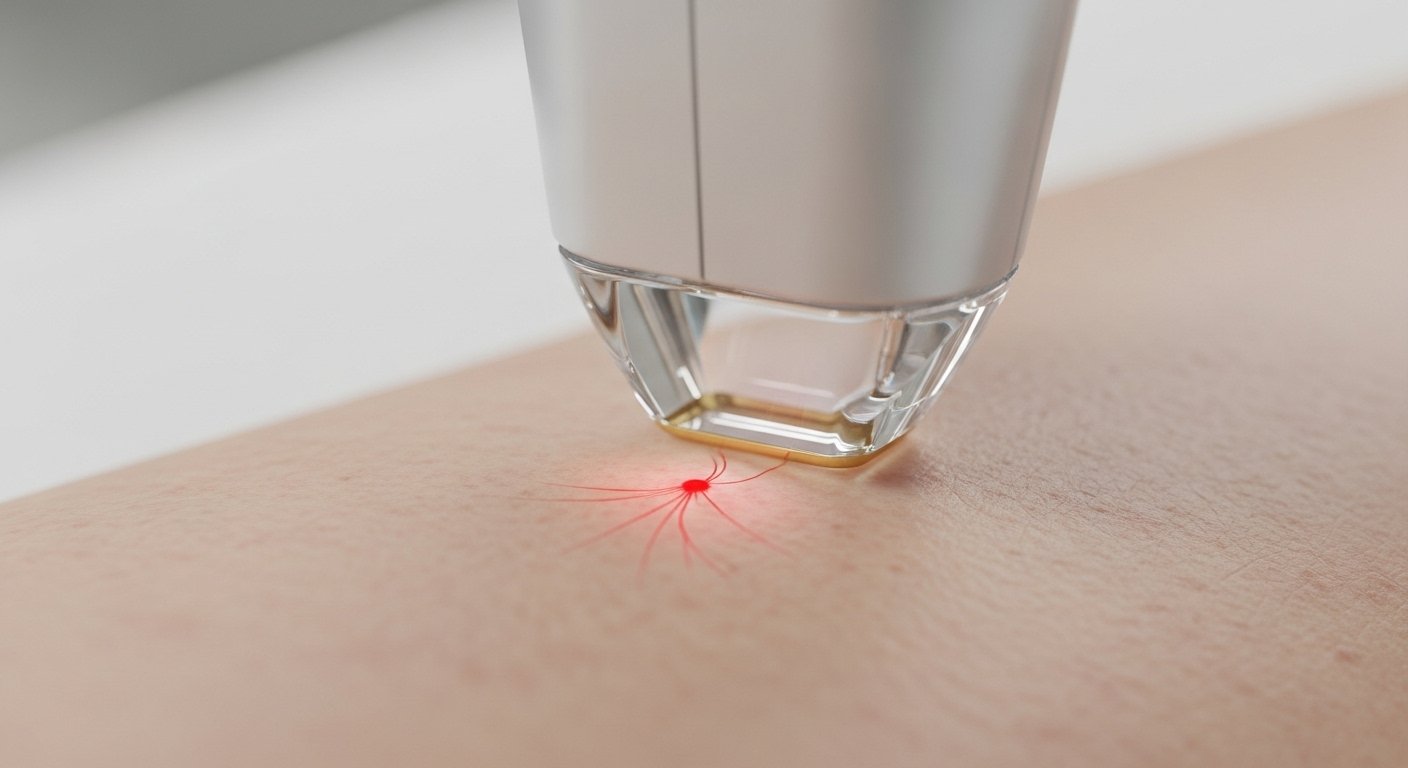
Vascular lesions such as spider veins, facial telangiectasia, and superficial vascular networks are common concerns for many individuals. Although they are mostly harmless, they can affect confidence and skin appearance. While people often associate the Q-Switched Nd:YAG laser with pigmentation and tattoo removal, this versatile technology also plays a significant role in treating vascular concerns safely and effectively.
In this blog, we will explore how the Q-Switched Nd:YAG laser treats vascular and spider veins, why it works, and what makes this technology medically valuable for various skin types.
Understanding Vascular & Spider Veins
Before exploring the science behind treatment, it’s important to understand what vascular lesions actually are.
What Are Spider Veins?
Spider veins (telangiectasias) are:
- Small dilated blood vessels near the surface of the skin
- Common on the face, legs, and nose
- Caused by genetics, sun exposure, hormonal shifts, heat, or pressure
They appear red, purple, or blue depending on their depth and diameter.
Why Do They Form?
Several factors contribute:
- Weakening of vessel walls
- Increased blood pressure inside superficial capillaries
- UV damage that breaks collagen and reduces vessel support
- Inflammation and aging of dermal tissues
Regardless of the cause, the goal of treatment is to destroy the unwanted vessel while preserving the surrounding skin.
Why a Laser Can Treat Blood Vessels
Laser vein treatment is based on a principle called Selective Photothermolysis — a concept that completely transformed modern aesthetic medicine.
Selective Photothermolysis in Simple Terms
Selective photothermolysis means:
A laser targets a specific color or chromophore in the tissue, heats it rapidly, and destroys it without harming nearby structures.
For vascular treatments, the chromophore is oxyhemoglobin, the molecule that gives blood its red color.
So why does the Q-Switched Nd:YAG work?
Because it can:
- Deliver energy in very short pulses
- Produce wavelengths (especially 532 nm) that are strongly absorbed by oxyhemoglobin
- Target vessels with precision
This makes it an excellent option for small vascular lesions, especially on the face.
Q-Switched Nd:YAG Laser: How It Targets Veins
A Q-Switched Nd:YAG laser typically emits:
- 532 nm (green light)
- 1064 nm (infrared light)
Both wavelengths have therapeutic uses in vascular treatments.
1. The 532 nm Wavelength: Perfect for Superficial Vessels
This wavelength:
- Has high absorption in oxyhemoglobin
- Treats fine red vessels close to the skin’s surface
- Is ideal for facial spider veins, cherry angiomas, and small telangiectasias
How it works:
The 532 nm beam quickly heats the blood inside the vessel. This causes:
- Coagulation of blood
- Collapse of the vessel wall
- Gradual elimination by the body’s lymphatic system
Because the pulse is Q-switched (extremely short), the surrounding skin is protected from excessive heat.
2. The 1064 nm Wavelength: For Deeper and Larger Vessels
Although the 1064 nm wavelength is more commonly used for:
- Deep hair follicles
- Pigmented lesions
- Tattoo ink
It also serves a role in vascular therapy for:
- Deeper blue veins
- Leg spider veins
- More stubborn vascular networks
The 1064 nm wavelength penetrates deeper and scatters less, making it suitable for vessels located 1–3 mm beneath the surface.
The Science Behind the Pulse: Why Q-Switched Matters
The Q-Switched mechanism generates ultra-short pulses (in nanoseconds), which is crucial for:
- Preventing prolonged heat damage
- Delivering very high peak power
- Breaking down oxyhemoglobin efficiently
Unlike long-pulse lasers that rely on thermal coagulation, Q-switched pulses produce a combination of:
- Photothermal effect (heat damaging the vessel)
- Photomechanical effect (pressure waves that disrupt vessel walls)
This dual action increases effectiveness while lowering the risk of pigment changes in the skin.
What Happens Inside the Vessel During Treatment?
When the pulse hits the vessel:
- Oxyhemoglobin absorbs the laser energy
- This absorption is strongest at 532 nm.
- The blood rapidly heats
- Causing coagulation inside the vessel.
- Vessel wall collapses
- The heat damages the endothelial lining.
- The vessel seals shut
- Blood stops flowing through that capillary.
- The body naturally clears it
- Over days to weeks, the vessel is broken down and absorbed.
This process allows for selective destruction of unwanted vessels while keeping the surrounding skin intact.
Why This Treatment Is Safe for Most Skin Types
The Nd:YAG platform is known for:
- Lower melanin absorption
- Higher safety in darker skin tones
- Reduced risk of hyperpigmentation
The 1064 nm wavelength especially is much safer for Fitzpatrick skin types IV–VI compared to other vascular laser systems.
Key Benefits of Using Q-Switched Nd:YAG for Vascular Lesions
Here are the major clinical advantages:
Precise targeting of tiny facial vessels
Especially those around the nose and cheeks.
Minimal risk of damage to surrounding skin
Because pulses are extremely short.
Fast treatments
Small vascular lesions can often be treated in minutes.
Suitable for multiple skin types
Especially when using the 1064 nm wavelength.
Dual wavelength versatility
532 nm for superficial vessels
1064 nm for deeper veins
No downtime
Patients can return to normal activity immediately.
What Types of Vascular Lesions Can Be Treated?
The Q-Switched Nd:YAG can address:
- Spider veins
- Telangiectasia
- Cherry angiomas
- Diffuse facial redness
- Rosacea-related vascular networks
- Small leg veins
- Post-inflammatory vascular marks
- Broken capillaries from sun damage
This makes the laser useful for both aesthetic improvement and medical skin correction.
What Patients Should Expect
During Treatment
- Mild heat or snapping sensation
- Quick pulses
- No need for anesthesia for most facial areas
After Treatment
- Temporary redness
- Occasional darkening of the vessel before it fades
- Gradual improvement over 2–6 weeks
Number of Sessions
Most vascular lesions require:
- 1–3 sessions for small facial veins
- 3–6 sessions for more complex or deeper vessels
Why Q-Switched Nd:YAG Is a Valuable Addition to a Clinic
Clinics benefit from this technology because it offers:
- High safety
- Multi-purpose use
- Excellent ROI
- The ability to treat both vascular and pigmented lesions with the same platform
It is therefore one of the most versatile tools in medical aesthetics.
Final Thoughts
Although commonly associated with tattoo and pigment removal, the Q-Switched Nd:YAG laser is a scientifically advanced solution for treating vascular and spider veins. Its ability to selectively target oxyhemoglobin, deliver energy with extreme precision, and treat vessels at multiple depths makes it a powerful and safe technology for improving the appearance of vascular lesions.
With proper training, appropriate parameters, and safe protocols, this laser delivers excellent medical and aesthetic outcomes across a wide range of clients and skin types.